Agency vs Platform vs System: The Three Models for B2B Outbound in 2026
There are three ways to build outbound: hire an agency, buy a platform, or plug into a managed system. Here's what each model actually delivers and what it costs.
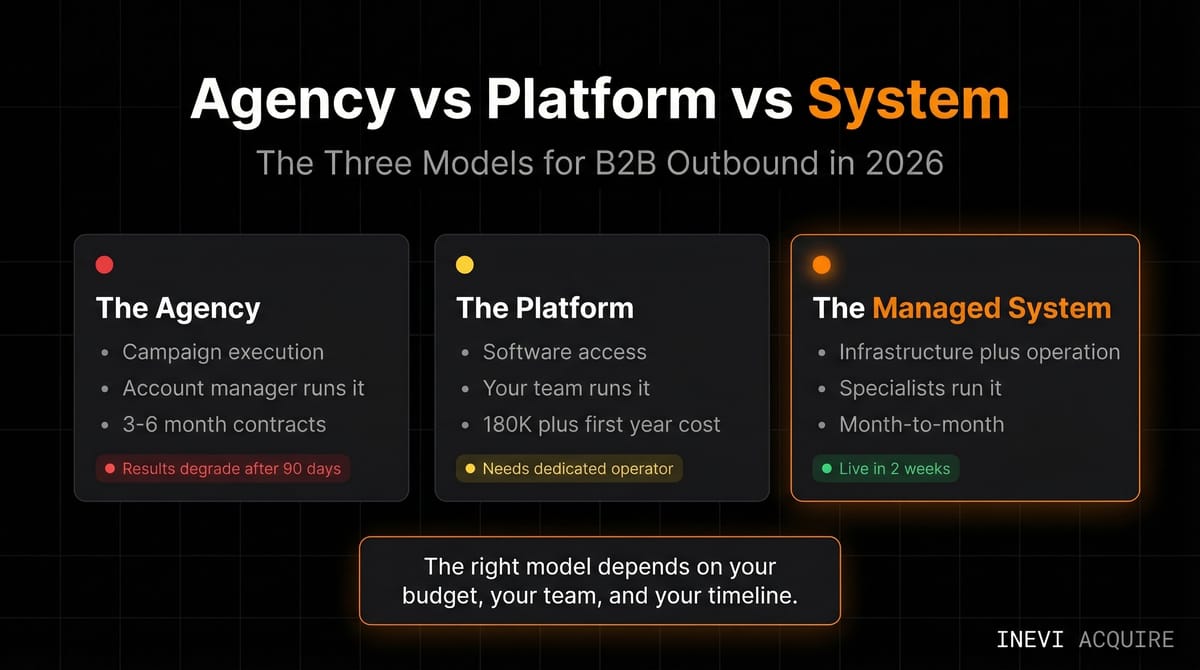
Agency vs Platform vs System: The Three Models for B2B Outbound in 2026
Every B2B company building outbound right now faces the same decision: who actually runs it?
Not which tool. Not which channel. Who runs it.
There are three models. Each one works for a specific type of company. Each one fails for the others. The problem is that most companies pick a model without understanding what they're buying — and spend 3-6 months figuring out it was the wrong one.
Here's how each model actually works, what it costs, and who it's right for.
The Three Models at a Glance
A B2B outbound model is the operational structure that determines who builds, manages, and optimizes your outbound pipeline. The three dominant models in 2026 are: traditional agencies that run campaigns for you, self-serve platforms you operate yourself, and managed systems that combine infrastructure with ongoing operation.
Model 1: The Agency
Agencies are the default choice for companies that want outbound without building a team. You pay a monthly retainer. They buy lists, write sequences, send emails, and report on activity metrics.
How It Works
A typical outbound agency assigns you an account manager who handles 15-30 other accounts. They pull a list from a single data provider (usually ZoomInfo or Apollo), write a 3-4 email sequence, load it into a sending tool, and report weekly on opens, clicks, and replies.
The pitch is simple: we handle outbound so you don't have to.
Where It Works
Agencies work for companies that need volume quickly and have a proven product-market fit. If your close rate is strong and you just need more at-bats, an agency can fill the top of the funnel — at least for the first 60-90 days.
Where It Breaks
The agency model has a structural problem: incentives.
Most agencies sell meeting quotas. They promise 20-30 meetings per month. This sounds great until you realize what it incentivizes: booking meetings with anyone who will take a call, regardless of fit. Your sales team wastes hours on unqualified conversations. Your brand takes a hit from aggressive outreach that prospects didn't ask for.
The 90-day cliff: Agency results almost always degrade after the first quarter. Why? They exhaust the easy targets on their initial list. The sequences that worked in month one stop working in month three because they're not adapting to new signals — they're just pulling the next batch from the same static list.
A 2025 analysis of outbound agency churn found that 68% of clients leaving agencies cited "declining meeting quality" as the primary reason, not cost.
The data problem: Most agencies use a single data source. If that source has bad emails, incomplete records, or outdated contacts, every campaign suffers. They don't cross-reference across providers because it's expensive and slows down their workflow — and their workflow is optimized for volume, not accuracy.
What It Costs
$3,000-10,000/month, typically with a 3-6 month minimum commitment. The real cost includes wasted sales time on unqualified meetings and brand damage from low-quality outreach — numbers that never appear on the invoice.
Model 2: The Platform
Platforms are self-serve tools that give you the technology to build outbound yourself. Clay, Apollo, Instantly, Lemlist, Outreach — the landscape has exploded since 2023. Each tool does one or two things well. None of them does everything.
How It Works
You sign up for a platform (or more likely, 3-5 of them). You configure workflows, connect data sources, build sequences, manage sending infrastructure, and optimize campaigns. The platform provides the technology. You provide the strategy, the execution, and the person who makes it all work.
Where It Works
Platforms work for companies that have a dedicated operations person — someone who can evaluate tools, build workflows, manage deliverability, and optimize campaigns full-time. If you have a strong RevOps or Sales Ops hire with experience in outbound tooling, the platform model gives you maximum control and data ownership.
Where It Breaks
The platform model breaks when you don't have the operator.
Here's the math most companies don't do before signing up: you need 6-8 tools to build a complete signal-based outbound system. A signal detection tool, a data enrichment tool, an email finder, an email verification tool, a sequencing tool, a deliverability tool, and something to orchestrate the workflow. Each tool costs $200-2,000/month. That's $1,200-16,000/month in software alone.
But the software is the smaller cost. The bigger cost is the person who runs it.
A GTM engineer — the emerging role that combines revenue operations with tool stack engineering — costs $120,000-150,000/year. That's before the 3-month ramp to evaluate which tools actually work together, followed by another 3 months of optimization before the system produces consistent results.
The complexity wall: Every company that tries the platform path hits the same wall. The tools each do their job, but connecting them is where the real work lives. Getting Clay to feed qualified companies into your enrichment layer, making sure the enrichment data routes correctly to your sequencing tool, maintaining deliverability across multiple sending domains — this is a full-time job, not a side project.
A recent survey of B2B SaaS founders found that 73% who started evaluating outbound tools were still in "research mode" after 30 days, having signed up for 3+ free trials without launching a single campaign.
What It Costs
Software: $1,200-16,000/month across 6-8 tools. Operator: $120,000-150,000/year for a GTM engineer (or $60,000-80,000 for an SDR who won't have the technical skills to build the stack). Time: 3-6 months before the system runs reliably. Total first-year cost: $180,000-330,000.
Model 3: The Managed System
The managed system is the newest model. Instead of buying campaigns (agency) or buying software (platform), you're plugging into infrastructure that's already built and operated by people who specialize in running it.
How It Works
A managed system provider has already built the complete outbound infrastructure — signal detection, multi-source data enrichment, email verification, sequencing, deliverability management, and workflow orchestration. They've already done the tool evaluation, the integration work, and the optimization. You plug your ICP into their system, and it runs.
The key difference from an agency: you're not buying meetings. You're buying the system. The system detects signals (funding rounds, hiring patterns, tech adoption), qualifies companies against your ICP, enriches contacts from multiple data sources, verifies every email address, and sends personalized outreach triggered by the signal that surfaced the company.
Where It Works
The managed system works for companies that want the output of a GTM engineer and a complete tool stack without the 6-month build time. Growth-stage B2B SaaS ($1M-$20M ARR) and B2B services firms ($500K-$15M) are the sweet spot — big enough to afford managed services, small enough that building in-house doesn't make sense yet.
Where It Breaks
The managed system model is wrong for two types of companies: those large enough to have a dedicated sales operations team (100+ employees with RevOps), and those too early to afford managed services (under $1M revenue). If you already have the operator and the tools, you don't need someone else to run the system. If you're not yet at the stage where managed services make financial sense, outbound probably shouldn't be outsourced at all.
What It Costs
The system is already built. The parallel build model means email domains warm up during the two weeks while the system is configured for your ICP, so you're live by week three.
How to Choose
The right model depends on three things: your budget, your team, and your timeline.
Choose an agency if: - You need meetings fast and have strong close rates - You have budget for a 3-6 month test - You're okay with meeting quality that may decline after quarter one - You don't need full data ownership or transparency into the process
Choose a platform if: - You have (or will hire) a dedicated ops person - You want maximum control over every variable - You have 3-6 months to build and optimize - Your budget supports $180K+ in first-year costs (tools + operator)
Choose a managed system if: - You want the system running in weeks, not months - You don't have (and don't want to hire) a GTM engineer - You want flexibility and speed, not long build times - You want signal-based targeting, not list-based blasting
The Question Most Companies Skip
Most companies start the outbound conversation with "which tool should we use?" or "which agency should we hire?"
The better question is: "What model fits our team, our budget, and our timeline?"
An agency costs less upfront than building in-house, but the results degrade. A platform gives you control, but demands a dedicated operator. A managed system gives you speed and expertise, but means trusting someone else with your pipeline.
There's no universally right answer. But there is a right answer for your company right now — and it starts with understanding what each model actually delivers.
FAQ
What's the difference between an outbound agency and a managed outbound system?
An agency buys lists and runs campaigns, typically selling a quota of meetings per month. A managed system is pre-built signal-based infrastructure operated by specialists — you're buying the system and the expertise, not a meeting count. The incentive structure is fundamentally different: agencies optimize for volume, systems optimize for quality.
How much does it cost to build outbound in-house with platforms?
The total first-year cost for a platform-based approach is $180,000-330,000, including 6-8 tools at $1,200-16,000/month in software costs plus a GTM engineer at $120,000-150,000/year. This doesn't account for the 3-6 month ramp before the system produces consistent results.
Can I switch from one outbound model to another?
Yes, and many companies do. A common path is: try DIY with platforms, hit the complexity wall, then switch to either an agency or managed system. The managed system model is designed for this — you can bring the system in-house once your team is ready.
What is a GTM engineer and why are they so hard to hire?
A GTM engineer combines revenue operations expertise with technical tool stack engineering — they evaluate, connect, and optimize the 6-8 tools needed for modern outbound. The role barely existed before 2024, and demand far outstrips supply. Salaries range from $120,000-150,000, and even at that price, most companies can't find qualified candidates.
Why do agency results decline after 90 days?
Agencies typically exhaust the highest-quality prospects from their initial list in the first quarter. Without signal-based targeting that surfaces new prospects as buying signals appear, they fall back on diminishing-quality contacts from the same static data source. The sequences that worked in month one stop performing because the audience quality dropped, not because the messaging changed.
What does "signal-based outbound" mean?
Signal-based outbound triggers every outreach based on a real event — a company raising funding, posting a relevant job listing, adopting new technology, or showing other buying signals. This is the opposite of list-based outbound, which sends emails to static lists regardless of timing or relevance.
Want to see which signals your ideal customers are sending right now? Get a free Signal Audit — no commitment, no card required.